


Vaginal Laxity vs Pelvic Organ Prolapse
“Is this just looseness, or is something actually falling out of place?” It’s a question many women silently worry about after childbirth, and one that deserves a clear, non-alarming answer.
At Ahalya Cosmetic Gynecology, Mumbai, Dr. Jay Mehta, Gynec Surgeon, sees this confusion often and for good reason, since the two conditions can feel similar but are medically quite different.
Vaginal laxity is a feeling of looseness in the tissue itself, while pelvic organ prolapse involves an actual organ shifting downward and knowing which one you’re dealing with is important when considering vaginal tightening treatment in Mumbai and choosing the right approach.

DR JAY MEHTA
Key Takeaways:
- Vaginal laxity is a tissue-tone concern; pelvic organ prolapse is a structural support issue involving an organ
- Prolapse usually comes with a visible or felt “bulge,” while laxity typically doesn’t
- Both can share causes like childbirth and ageing, but they aren’t the same condition
- A clinical pelvic exam is the only reliable way to tell them apart
- Having laxity does not automatically mean you have or will develop prolapse
What Do These Two Terms Actually Mean, in Plain Language?
Let’s define both clearly, since the confusion usually starts here.
- Vaginal laxity refers to the vaginal tissue itself feeling loose or less firm than before — it’s about tone and elasticity, not about anything physically moving out of place.
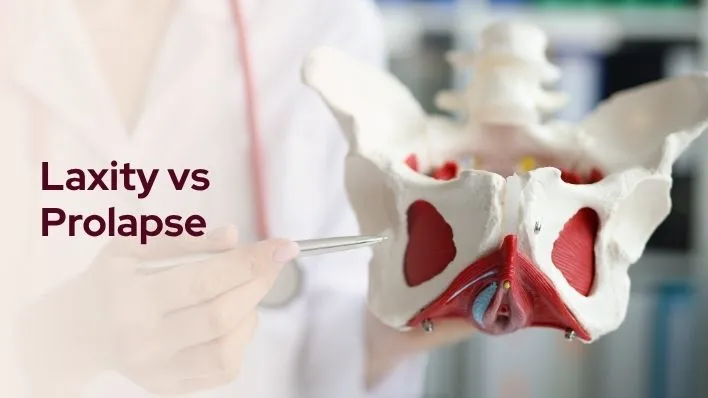
- Pelvic organ prolapse (POP) happens when one of the pelvic organs — typically the bladder, uterus, or rectum — loses its normal support and descends into or beyond the vaginal canal, sometimes becoming visible at the vaginal opening.
- The key distinction: laxity is a tissue-quality issue; prolapse is a structural support failure involving an actual organ.
- If you want a clinical reference point beyond this overview, the U.S. National Library of Medicine’s MedlinePlus entry on uterine prolapse is a reliable starting point for understanding how prolapse is formally defined and staged.
TALK TO US
GET IN TOUCH ON
What Causes Each Condition, and Do They Overlap?
These conditions share some root causes, which is exactly why they get confused.
- Both are commonly linked to vaginal childbirth, particularly with larger babies, prolonged labour, or multiple deliveries, since both involve stress on pelvic tissues and supportive structures. If you’re wondering whether looseness after delivery will resolve on its own, our detailed piece on whether vaginal looseness after delivery is permanent or temporary breaks down the typical recovery timeline.
- Vaginal laxity relates mainly to the vaginal walls’ collagen and elastin content and pelvic floor muscle tone.
- Prolapse relates to the ligaments and connective tissue that hold the pelvic organs in position — when these weaken significantly, gravity does the rest.
- Ageing, menopause, chronic straining (from constipation or heavy lifting), and obesity increase risk for both conditions, which is why they often appear together in the same patient.
How Serious Can Each One Become If Left Unaddressed?
The stakes differ meaningfully between the two.
- Vaginal laxity, even when persistent, is not medically dangerous — its main impact is on comfort, sensation, and confidence rather than organ function.
- Pelvic organ prolapse can progressively worsen if unaddressed, potentially leading to increasing discomfort, difficulty with bladder or bowel emptying, and in advanced cases, organ tissue exposure and irritation.
- This is the most important distinction to remember: laxity is generally a quality-of-life issue, while prolapse can become a functional health issue that benefits from earlier attention.
How Do We Tell Them Apart During an Examination?
You don’t need to self-diagnose this — but here’s what a clinical assessment looks for.
- A pelvic examination checks whether pelvic organs are in their normal anatomical position or have descended, which is the clearest way to confirm or rule out prolapse.
- A “bulge test”, where you’re asked to bear down as if straining, often reveals a prolapse that isn’t obvious at rest.
- Vaginal wall tone and muscle strength assessment separately evaluates laxity, independent of whether prolapse is present.
- Symptom-based clues can guide suspicion beforehand: a sensation of “something sitting low” or a visible bulge points toward prolapse, while a general looseness without any bulge sensation points toward laxity alone.
|
Feature |
Vaginal Laxity |
Pelvic Organ Prolapse |
|
What it involves |
Loose vaginal tissue/muscle tone |
An organ (bladder, uterus, rectum) descending |
|
Visible bulge |
No |
Often yes, especially on straining |
|
Main impact |
Comfort, sensation, confidence |
Comfort plus potential bladder/bowel function issues |
|
Typical first treatment |
Pelvic floor therapy, non-surgical tightening |
Pelvic floor therapy, pessary, or surgical repair |
|
Urgency to address |
Elective, quality-of-life driven |
Best assessed sooner if progressing |
How Are They Treated Differently?
Because the underlying problem is different, so is the fix.
- Vaginal laxity treatment focuses on the tissue and muscle: pelvic floor therapy, non-surgical radiofrequency tightening, or vaginoplasty for more significant cases — our guide on vaginal tightening treatment causes, symptoms, and solutions covers these options in more depth.
- Pelvic organ prolapse treatment depends on severity and which organ is involved — options range from pelvic floor therapy and a supportive pessary device for mild-to-moderate cases, to surgical repair (such as reconstructive pelvic floor surgery) for more advanced prolapse. If you’re specifically wondering whether prolapse can improve without surgery, Can Pelvic Organ Prolapse Be Reversed? walks through what non-surgical management can and can’t achieve.
- The overlap: pelvic floor therapy genuinely benefits both conditions, which is often why it’s recommended as a starting point regardless of the diagnosis.
If you’re unsure which one applies to you, Dr. Jay Mehta at Ahalya Cosmetic Gynecology, Mumbai, can give you a clear diagnosis through a straightforward pelvic examination rather than leaving you to guess.
What Does Recovery Look Like for Each?
- Laxity treatments generally involve shorter recovery — non-surgical options have minimal downtime, while vaginoplasty typically needs 6–8 weeks.
- Prolapse treatments vary more widely — a pessary requires no downtime at all, while surgical prolapse repair recovery can take 6–12 weeks depending on the extent of the procedure.
How Does Each Condition Affect Daily Life Differently?
- Laxity mainly affects intimacy and self-confidence, without typically limiting physical activity.
- Prolapse can affect daily physical comfort more broadly — some women notice a dragging or heaviness sensation, especially after standing for long periods, along with possible bladder or bowel changes.
Can One Lead to the Other Over Time?
- Having vaginal laxity does not mean prolapse is inevitable. They can exist independently, and many women have one without the other.
- However, since they share risk factors, addressing pelvic floor strength early — through therapy — offers some protective benefit for both, which is one more reason it’s often recommended proactively after childbirth.
Final Thoughts
Vaginal laxity and pelvic organ prolapse can feel similar from the inside, but they are distinct conditions with different implications and treatments.
Laxity is about tissue and muscle tone; prolapse is about an organ’s structural support. A simple pelvic examination clarifies which one you’re dealing with, and from there, a clear, appropriate treatment path can be built.
If you’d like that clarity in person, you can visit Ahalya Cosmetic Gynecology in Ghatkopar, Mumbai for a consultation — so there’s no need to carry uncertainty about this any longer than necessary.
Frequently Asked Questions (FAQs)
1. Can prolapse happen without any noticeable symptoms?
Yes, mild prolapse can sometimes be present with minimal or no symptoms and may only be identified during a routine gynaecological exam.
2. Does prolapse always require surgery?
No, mild-to-moderate prolapse is often managed successfully with pelvic floor therapy or a pessary device, with surgery reserved for more advanced or bothersome cases.
3. Can prolapse recur after surgical repair?
Yes, there is some chance of recurrence over time, particularly with continued risk factors like heavy lifting or future pregnancies, which is why follow-up care matters.
4. Is a heaviness feeling in the pelvis always a sign of prolapse?
Not always, since pelvic heaviness can also come from muscle fatigue or other causes, but it’s a symptom worth having properly evaluated rather than ignored.
5. Can young women who haven't had children develop prolapse?
It’s less common, but yes — connective tissue conditions, chronic heavy lifting, or chronic constipation can contribute to prolapse even without childbirth.
Related Blogs

When Vaginal Itching Needs a Doctor’s Visit?
Itching isn’t always an infection. Mumbai’s Dr. Jay Mehta explains the real causes, and when self-treatment isn’t the right approach.

Surgical Treatment for Perineal Endometriosis: Wide Excision Explained
A painful lump that worsens with your period isn’t ordinary scar pain. Mumbai’s Dr. Jay Mehta explains diagnosis and when excision is needed.
Book Appointment
