


Is Vaginal Looseness After Delivery Permanent or Temporary?
This is one of the most common questions we hear at Ahalya Cosmetic Gynecology, Mumbai, and it deserves a straight, honest answer rather than vague reassurance.
Dr. Jay Mehta, Gynec Surgeon at our Mumbai clinic, explains it simply: for many women, vaginal looseness after delivery is temporary and improves within several months, but for a smaller group, the tissue doesn’t fully bounce back on its own and that’s where the right guidance makes all the difference.


DR JAY MEHTA
- Mild vaginal looseness after delivery is common and often improves within 6–12 months
- Certain factors larger baby, forceps delivery, multiple pregnancies make full natural recovery less likely
- Vaginal laxity is different from pelvic organ prolapse, though people often confuse the two
- Pelvic floor therapy, non-surgical tightening, and surgical options exist depending on severity
- You don’t have to just “live with it” there are real, evidence-based solutions
What Does “Vaginal Looseness” Actually Mean?
Let’s start with what this term really refers to, because it’s talked about a lot but rarely explained clearly.
Vaginal laxity simply means the vaginal tissues have lost some of their natural tightness or tone. It’s a subjective, self-reported feeling meaning there’s no blood test or scan that measures it directly.
You feel it, your partner may notice it, and that’s valid information even without a clinical number attached to it.
It’s more common than people admit. Studies suggest it affects roughly a quarter to nearly half of women who’ve had a vaginal delivery, yet very few bring it up with their doctor.
It’s not about hygiene or “doing something wrong.” This is a mechanical and tissue-level change, not a reflection of how well you took care of yourself.
It ranges widely in severity from a mild sensation of looseness to more noticeable changes affecting daily comfort.
TALK TO US
GET IN TOUCH ON
Why Does Childbirth Cause This in the First Place?
The vaginal canal stretches significantly during delivery to allow the baby to pass through. The tissue is designed to be elastic, but there are limits.
Collagen and elastin, the proteins that give tissue its firmness and “bounce-back” ability, get depleted during pregnancy and delivery, especially with vaginal births.
Pelvic floor muscles, which act like a supportive sling for the vagina, bladder, and uterus, can weaken from the stretching and pressure of labour.
Certain factors increase the risk: a larger baby, forceps or vacuum-assisted delivery, multiple vaginal deliveries, prolonged pushing, or significant tearing during birth.
The pelvic floor changes that follow aren’t limited to laxity alone prolapse can develop alongside it, and understanding which exercises are safe when pelvic floor structures are already compromised is important; our guide on exercising safely with pelvic organ prolapse gives a clear framework for this.
Is It Temporary, or Does It Stay Forever?
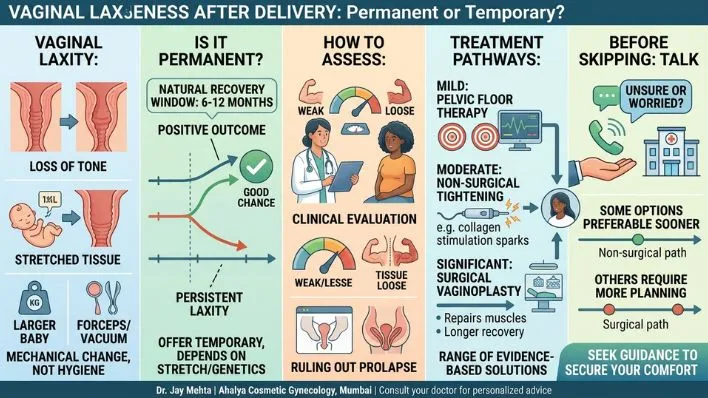
For many women, the first 6 to 12 months postpartum bring noticeable natural improvement as hormones stabilize, swelling resolves, and muscle tone gradually returns especially with consistent pelvic floor engagement.
However, if the stretching was significant, or collagen quality was already reduced due to age or genetics, full natural recovery may not happen. The tissue can remain looser than it was pre-pregnancy indefinitely.
Multiple deliveries compound the effect. Each vaginal birth adds further stretch, so laxity is more likely to persist after a second or third child.
Age matters too. Vaginal tissue naturally loses elasticity over time regardless of childbirth, so laxity from delivery can overlap with and be worsened by age-related changes, especially closer to and after menopause.
The honest takeaway: if you’re past the one-year postpartum mark and things haven’t improved, it’s unlikely to resolve entirely on its own, and that’s a completely normal thing to seek help for.
How Do We Assess Whether It Will Resolve on Its Own?
A pelvic examination allows us to assess vaginal tone, tissue quality, and muscle strength directly.
Pelvic floor strength testing helps determine whether weakness is muscular (often improvable with therapy) or more related to tissue laxity (which may need a different approach).
Ruling out pelvic organ prolapse is an important part of this prolapse involves an organ physically shifting downward, and it needs a different treatment conversation than laxity alone.
Discussing your symptoms and goals, whether it’s physical comfort, sensation during intimacy, or confidence, helps shape the right plan for you specifically.
What Are the Options If It Doesn’t Improve Naturally?
Pelvic floor physical therapy is usually the first line of treatment. A trained therapist guides you through targeted exercises that go far beyond generic Kegels, often with biofeedback to ensure you’re engaging the right muscles correctly.
Non-surgical vaginal tightening treatments, such as radiofrequency-based procedures, work by stimulating new collagen production in the vaginal walls. These are performed as outpatient procedures with minimal downtime and are suited to mild-to-moderate laxity.
Surgical vaginoplasty is reserved for more significant laxity or when non-surgical options haven’t given adequate results.
If you’re trying to understand the practical difference between these two approaches what each involves, how results compare, and how to know which one your situation calls for our detailed guide on the difference between vaginal tightening and vaginoplasty covers both options side by side.
This procedure tightens the vaginal canal by repairing the underlying muscle and removing excess lax tissue, and it offers a more permanent result.
If you’ve been unsure whether your concerns are “worth” bringing up, they are. Book a consultation with Dr. Jay Mehta at Ahalya Cosmetic Gynecology, Mumbai, to get a clear, judgment-free assessment of where you stand and what would genuinely help.
What Can You Expect During Recovery?
Pelvic floor therapy typically shows initial improvement within 6–8 weeks of consistent sessions, with continued gains over a few months.
Non-surgical tightening procedures usually involve little to no downtime, though full collagen remodelling and visible results build gradually over 6–12 weeks.
Surgical vaginoplasty requires a more structured recovery period, generally around 6–8 weeks before resuming sexual activity and strenuous exercise, with final results settling in over subsequent months.
For a full breakdown of what each procedure entails, candidacy criteria, and what to expect at each stage, our vaginal tightening treatments page covers all options available at Ahalya Cosmetic Gynecology in detail.
How Does This Affect Daily Life and Confidence?
Reduced sensation during intimacy is one of the most commonly reported effects, and it can quietly strain confidence and closeness in a relationship.
Body image shifts after childbirth are common, and vaginal changes are often part of a larger adjustment many new mothers go through.
Many women stay silent about this out of embarrassment, even though it’s a routine, medically recognised concern that gynaecologists address regularly.
You deserve to feel comfortable in your own body again and talking about it openly with the right specialist is the first step.
Long-Term Prevention and Maintenance
Consistent, correctly performed pelvic floor exercises, ideally guided initially by a professional, help maintain muscle tone over the years.
Maintaining a healthy body weight reduces ongoing pressure on pelvic floor structures.
Attending regular gynaecological check-ups postpartum and beyond ensures any changes are caught and addressed early rather than left to worsen.
Final Thoughts
But when it persists beyond the first year, it’s not something you have to simply accept.
From pelvic floor therapy to non-surgical tightening to surgical vaginoplasty, there are clear, medically sound paths back to comfort and confidence, and help is always available when you’re ready for it.
Frequently Asked Questions (FAQs)
1. Does breastfeeding affect how quickly vaginal tightness returns?
2. Can I do too many Kegel exercises and cause harm?
3. Will a C-section prevent vaginal laxity completely?
4. Is it safe to have vaginal tightening treatment while still breastfeeding?
5. Can vaginal looseness come back again after successful treatment?
Related Blogs

When Vaginal Itching Needs a Doctor’s Visit?
Itching isn’t always an infection. Mumbai’s Dr. Jay Mehta explains the real causes, and when self-treatment isn’t the right approach.
Surgical Treatment for Perineal Endometriosis: Wide Excision Explained
A painful lump that worsens with your period isn’t ordinary scar pain. Mumbai’s Dr. Jay Mehta explains diagnosis and when excision is needed.
Book Appointment
