


What Is Perineal Endometriosis?
Finding a painful lump in your intimate area can feel incredibly frightening, especially when the pain worsens during your menstrual cycle.
If you are experiencing these symptoms, you might be dealing with a rare but manageable condition known as perineal endometriosis.
At Ahalya Cosmetic Gynecology in Mumbai, Dr. Jay Mehta and our dedicated team understand how isolating rare pelvic health concerns can feel.
We are here to help you understand exactly what is happening to your body and how we can treat it.
When looking for answers, you deserve care from the best cosmetic gynecology clinic in Mumbai.
Our goal is to provide you with clear, accurate medical information without overwhelming jargon. We combine clinical expertise with deep empathy to help you regain your comfort and quality of life.

DR JAY MEHTA
Key Takeaways
-
Perineal endometriosis is a rare subtype of extrapelvic endometriosis where endometrial-like tissue grows at or near the perineum — the area between the vaginal opening and the anus.
-
It most commonly develops at the site of an episiotomy scar following vaginal delivery, though it can occasionally occur without any surgical history.
-
The hallmark symptom is a painful, firm nodule that swells and aches in sync with the menstrual cycle.
-
It is frequently misdiagnosed as a cyst, abscess, or haemorrhoid, leading to months or even years of unnecessary suffering.
-
Surgical excision — complete removal of the lesion — is the most effective treatment, with significantly lower recurrence when combined with hormonal therapy.
-
Early recognition and specialist evaluation can prevent complications such as anal sphincter involvement.
What exactly is perineal endometriosis, and is it the same as regular endometriosis?
Yes and no. To understand perineal endometriosis, it helps to first understand what endometriosis means at its core.
Endometriosis is a condition where tissue that resembles the inner lining of the uterus — called the endometrium — begins growing in places it does not belong.
This tissue behaves just like the normal uterine lining: it thickens, breaks down, and bleeds with each menstrual cycle. But because it has nowhere to go, it causes inflammation, pain, and scarring.
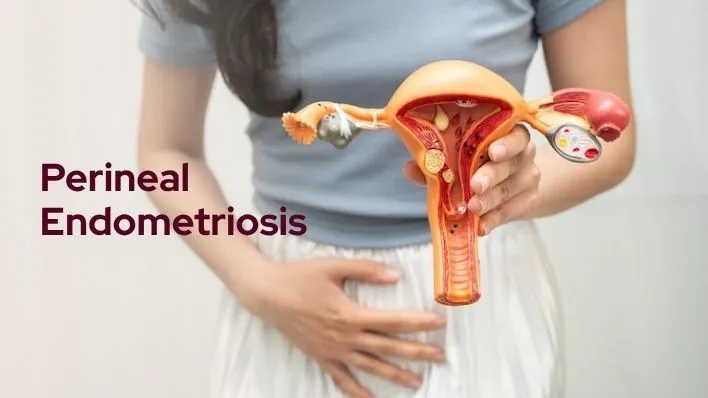
Perineal endometriosis (PEM) is a specific, rare form of this disease where that ectopic — meaning “out of place” — endometrial tissue grows in the perineum.
The perineum is the small but sensitive region of tissue located between the vaginal opening and the anus. It is an area that plays an important role in sitting, walking, sexual intercourse, and bowel function.
At Ahalya Cosmetic Gynecology, Mumbai, we consider perineal endometriosis one of the most underrecognised conditions in women’s intimate health.
Many of our patients arrive having been told for months that their pain is “just a cyst” or “probably haemorrhoids.” It is neither. It deserves a proper name, a proper diagnosis, and a proper treatment plan.
TALK TO US
GET IN TOUCH ON
Why does it happen? What causes endometrial tissue to grow near the perineum?
The most widely accepted explanation is called the implantation theory.
During a vaginal delivery, an episiotomy — a small surgical cut made to widen the vaginal opening — is often performed. In some cases, active endometrial cells that are present in the vaginal canal at the time of delivery get accidentally deposited into the freshly cut tissue of the perineum.
These cells, which are naturally programmed to respond to oestrogen, survive, implant, and start behaving like endometrial tissue. Each month, as oestrogen rises with the menstrual cycle, these misplaced cells swell, bleed internally, and cause pain.
This explains why perineal endometriosis is most commonly found at or near the episiotomy scar. A peer-reviewed retrospective study published in Medicine (Liu et al., 2020 — PMC7306333) found that 94.29% of perineal endometriosis cases were located directly at the episiotomy scar site.
Less commonly, perineal endometriosis can also occur through:
- Haematogenous or lymphatic spread — endometrial cells travelling through blood or lymph vessels
- Coelomic metaplasia — existing cells in the perineal region spontaneously transforming into endometrial-like cells
- Perineal trauma or laceration during delivery, even without a formal episiotomy
It is important to note that perineal endometriosis has been documented in rare cases in women who have never had a vaginal delivery, though this is far less common.
Who is at risk of developing perineal endometriosis?
The clearest risk factor is a history of episiotomy or perineal tear during vaginal delivery. However, risk is influenced by several factors:
- Women who have undergone one or more vaginal deliveries with episiotomy
- Women with a known history of pelvic endometriosis (as coexisting disease has been documented)
- Women with higher BMI at the time of delivery, as research from PMC7896645 indicates this is associated with a shorter incubation period — meaning symptoms develop sooner
- Women with a family history of endometriosis, which raises general susceptibility
The incubation period — the time between delivery and the first appearance of symptoms — typically ranges from 2 months to over 5 years. This wide range is one reason the condition is so often missed or dismissed.
Perineal endometriosis accounts for only 0.17% to 0.37% of all endometriosis cases [Liu et al., Medicine, 2020], making it genuinely rare. But for the woman experiencing it, that rarity is no comfort.
What does perineal endometriosis feel like? How do I recognise the symptoms?
This is the question that matters most to patients. The symptoms of perineal endometriosis are distinct, and recognising them is the first step toward getting help.
The defining symptom is a firm, tender nodule or lump near the perineum that becomes noticeably more painful and sometimes larger in the days leading up to and during menstruation.
Between cycles, the pain and swelling may partially subside — which is exactly what makes this condition unique.
Other symptoms commonly reported include:
- Cyclical perineal pain — pain that follows a predictable monthly pattern linked to the menstrual cycle
- Dyspareunia — pain during sexual intercourse, particularly with deep penetration
- Pain on sitting or walking, especially when the nodule is larger
- Pain during bowel movements, particularly if the lesion is near the anal sphincter
- A visible or palpable mass near the episiotomy scar or elsewhere on the perineum
- Occasional discharge from the lesion site in some cases
A patient scenario: A 31-year-old woman in Ghatkopar presented to our clinic after 14 months of cyclical perineal discomfort following her first delivery.
She had been reassured twice that it was a “healing issue” from the episiotomy. On examination, a firm 2 cm nodule was palpable at the scar site.
It was tender on touch and had clearly increased in size in the preceding week — the week of her period. This presentation is textbook perineal endometriosis.
If you recognise this pattern in yourself, please do not normalise it. Pain that follows your menstrual cycle, particularly at a scar site, is not routine and warrants evaluation.
How is perineal endometriosis diagnosed?
Diagnosis involves three things: clinical recognition, imaging, and tissue confirmation.
Clinical Evaluation: Three criteria, when all present together, have a predictive value of 100% for perineal endometriosis [Zhu et al., Int J Gynaecol Obstet, 2009]: (1) a history of episiotomy or perineal tear during vaginal delivery; (2) a tender nodule or mass at the perineal site; and (3) progressive, cyclical perineal pain. When all three are present, the diagnosis is virtually certain before any imaging.
Ultrasound (Transperineal): This is typically the first imaging tool used. A transperineal ultrasound — where the probe is placed gently against the perineal skin rather than internally — can identify the lesion’s size, depth, and nature.
Lesions typically appear as hypoechoic (dark on ultrasound) nodules with irregular borders. It is non-invasive, quick, and highly informative.
MRI (Magnetic Resonance Imaging): For deeper lesions or when there is suspicion of anal sphincter involvement, MRI provides superior detail.
It clearly delineates the extent of the lesion, its relationship to surrounding muscles and nerves, and helps surgeons plan the safest possible approach to excision.
Histopathological Confirmation: The definitive diagnosis is always made after surgery.
The excised tissue is examined under a microscope, and the presence of endometrial glands and stroma confirms the diagnosis conclusively.
How serious can it get? Are there different stages or complications?
Perineal endometriosis can vary in extent and severity. While in many cases the lesion remains confined to the superficial subcutaneous tissue near the scar, it can become more complex over time.
The most significant complication is when the lesion invades the anal sphincter — the ring of muscle that controls bowel continence.
This is termed PEM with anal sphincter involvement, and it is found in approximately 28.57% of cases in published series [Liu et al., 2020].
When this occurs, the risks during surgery increase substantially, as the sphincter must be carefully preserved to prevent faecal incontinence.
Other possible complications include:
- Formation of a fistula (an abnormal channel) between the perineum and rectum in advanced cases
- Significant scarring of the perineal tissue affecting sexual function and urinary flow
- Psychological distress from prolonged undiagnosed pain
This is why early diagnosis and timely referral to a specialist are not optional. The longer perineal endometriosis is left untreated, the more extensive the lesion may become, and the more complex the surgery required.
Book a Private Consultation at Ahalya Cosmetic Gynecology, Mumbai If you are experiencing cyclical perineal pain, a lump near an episiotomy scar, or any of the symptoms described above, we strongly encourage you to seek a specialist evaluation.
Our team at Ahalya Cosmetic Gynecology, Ghatkopar, Mumbai, led by Dr. Jay Mehta, offers compassionate, confidential consultations for women’s intimate health concerns.
What are the treatment options for perineal endometriosis in Mumbai?
According to data from ICMR-NIRRH, Mumbai, endometriosis affects approximately 42 million women in India — roughly 10% of all women of reproductive age.
While perineal endometriosis represents only a small fraction of these cases, the burden of undiagnosed and untreated disease in Indian women remains significant.
Treatment for perineal endometriosis involves two approaches, often used in combination:
- Surgical Excision (Primary Treatment) Complete surgical removal of the perineal lesion is the gold standard.
The goal is wide local excision — removing the entire nodule along with a small margin of healthy surrounding tissue (typically 1 cm) to reduce the risk of recurrence. Incomplete or narrow excision significantly raises the chance of the disease returning.
When the anal sphincter is involved, the surgery requires meticulous planning and skill. At Ahalya Cosmetic Gynecology, this type of complex excision is approached with advanced minimally invasive surgical techniques, detailed pre-operative imaging, and the highest standard of post-operative care.
- Hormonal (Medical) Therapy Hormonal treatments work by suppressing the menstrual cycle and reducing oestrogen levels, which deprives the endometrial tissue of the hormonal fuel it needs to grow and bleed.
Options include:
- GnRH agonists (Gonadotropin-releasing hormone agonists) — the most commonly used post-operative hormonal therapy, shown to reduce recurrence rates from approximately 18.75% to 7.69% when used following surgery [Liu et al., 2020]
- Oral contraceptive pills — useful for pain management and suppression before or after surgery
- Progestogens and danazol — provide partial symptom relief but do not reduce lesion size on their own
Medical therapy alone is generally not sufficient to resolve perineal endometriosis. It may reduce pain temporarily, but the nodule typically persists. Surgery followed by hormonal therapy offers the best long-term outcomes.
As a cosmetic gynecology expert in Mumbai, Dr. Jay Mehta emphasises the importance of tailoring treatment to each patient’s individual presentation, depth of lesion, sphincter involvement, and reproductive plans.
What should I expect during recovery after treatment?
Recovery after surgical excision of perineal endometriosis is generally well-tolerated, particularly when the lesion is confined and excised completely.
In the first week, mild to moderate perineal discomfort, swelling, and bruising are expected. Most women are mobile within 24–48 hours and can return to light daily activities within a week.
Complete healing of the perineal tissue typically takes 4 to 6 weeks. During this time:
- Avoid strenuous physical activity and sexual intercourse
- Maintain careful perineal hygiene — gentle washing with water, no harsh products
- Follow your prescribed antibiotic and pain relief course
- Attend all follow-up appointments for wound review and pathology confirmation
If hormonal therapy is prescribed post-operatively, this will typically continue for 3 to 6 months to reduce the risk of recurrence.
Long-term follow-up is important. Your specialist will monitor for any signs of recurrence at the scar site.
Women with a history of pelvic endometriosis may also require concurrent management for their broader endometriosis disease.
Is it normal to feel anxious, confused, or embarrassed about this condition?
Absolutely. And we want to say this clearly: your feelings are valid, and you have nothing to be embarrassed about.
Perineal endometriosis affects one of the most intimate areas of a woman’s body.
Many patients tell us they spent months dismissing their own pain, believing it was “not serious enough” to bring up, or feeling too self-conscious to describe the location of their discomfort to a doctor.
Some women carry the additional weight of having been told repeatedly that what they are experiencing is nothing to worry about. Being dismissed is exhausting, and it affects mental health.
We also understand that for many women in Mumbai and across India, talking about perineal pain — especially near the intimate area — carries cultural stigma. At Ahalya, every consultation is conducted with complete discretion, respect, and zero judgment.
Chronic pain, especially when cyclical and affecting daily life, can lead to anxiety, disrupted sleep, and low mood.
If you are struggling emotionally alongside your physical symptoms, please tell us. Holistic care at Ahalya means attending to your emotional wellbeing alongside your medical treatment.
You are not overreacting. You are not imagining the pain. And you deserve proper answers.
Can perineal endometriosis come back, and how can I prevent it?
Recurrence is possible but significantly manageable with the right approach.
Studies show that recurrence after surgery alone occurs in approximately 18.75% of patients, while patients who receive GnRH agonist therapy post-operatively see that rate drop to approximately 7.69% [Liu et al., Medicine, 2020]. This strongly supports the combined surgical and hormonal approach.
For long-term prevention and monitoring:
- Attend regular follow-up appointments, especially in the first 12 months post-surgery
- Report any new or returning pain at the episiotomy site promptly — early re-intervention is far simpler than treating a larger recurrent lesion
- Discuss the appropriate hormonal management strategy with your specialist based on your personal health profile and family planning needs
- If you are planning another vaginal delivery in the future, inform your obstetrician of your history so that episiotomy management can be handled with particular care
For perineal endometriosis treatment in Mumbai, a thorough pre-operative assessment, experienced surgical technique, and a structured post-operative plan remain the strongest combined defence against recurrence.
Frequently Asked Questions (FAQs)
1. Can perineal endometriosis occur in women who have never had an episiotomy?
Yes, though it is uncommon. In very rare cases, perineal endometriosis has been reported in women without any history of delivery or surgery. In these instances, the cause is thought to involve haematogenous spread (through the bloodstream) or spontaneous cellular change in the perineal tissue. Any woman with cyclic perineal pain should be evaluated regardless of obstetric history.
2. Will perineal endometriosis affect my ability to have another baby?
Perineal endometriosis itself does not directly impair fertility, as it is located outside the reproductive tract. However, if you have coexisting pelvic endometriosis, that may require separate evaluation regarding fertility. Your surgeon will assess the full picture at the time of your consultation.
3. How do I know if my perineal pain is endometriosis and not something else like a cyst or haemorrhoid?
The distinguishing feature is cyclicality. Perineal endometriosis pain typically intensifies before and during menstruation and partially improves between cycles. A haemorrhoid or sebaceous cyst does not follow this pattern. A transperineal ultrasound performed by an experienced specialist can usually differentiate these conditions reliably.
4. Is the surgery to remove perineal endometriosis painful or risky?
When performed by an experienced surgeon, perineal excision is a well-tolerated procedure. The area is managed under appropriate anaesthesia, and most women return to light activity within a few days. The main risk in complex cases involving the anal sphincter is damage to sphincter function, which is why surgeon experience and pre-operative MRI planning are so important.
Conclusion
Perineal endometriosis is rare — but for the women living with it, it is a very real source of daily pain, confusion, and distress.
What makes this condition particularly difficult is that it sits at the intersection of two things: an intimate location that many women feel uncomfortable discussing, and a medical presentation that is frequently misread as something else entirely.
The key message from our team at Ahalya Cosmetic Gynecology, Mumbai is this: cyclical perineal pain, especially near an old episiotomy scar, is not something to ignore or normalise.
It has a name, a clear diagnosis pathway, and effective treatment. The earlier it is identified, the simpler and safer the treatment.
You deserve care that listens, investigates thoroughly, and treats you with respect. If any part of this article resonates with your experience, we encourage you to take the next step and seek a specialist evaluation.
Related Blogs
Perineal Endometriosis Causes and Risk Factors: Episiotomy, C-Section and More
Painful lump near episiotomy or C-section scar? It could be perineal endometriosis. Learn causes, symptoms & treatment. Expert care in Mumbai.
Pregnancy & Vaginismus: What Every Woman Should Know
Vaginismus doesn’t cause infertility — pregnancy is possible naturally or via IUI/IVF. Expert care at Ahalya Cosmetic Gynecology, Mumbai.

Vaginismus: Causes, Symptoms, Diagnosis & Treatment
Vaginismus causes involuntary muscle spasms, making penetration painful. Learn about symptoms, diagnosis, and effective treatments including physiotherapy and Botox.
Recurring UTIs After Sex: Causes, Prevention, and When to Worry
Sex moves bacteria toward your urethra, causing UTIs. Urinate after sex, stay hydrated & see a specialist if infections recur 3+ times a year.

Pelvic Floor Therapy Costs & Affordable Options for Teens
Pelvic floor therapy in Mumbai. Affordable teen options include virtual care & home programmes. Expert help at Ahalya Cosmetic Gynecology.
Pregnancy Exams with Vaginismus & Vulvodynia: What to Expect
Pregnancy exams with vaginismus can be gentle and customised. Discover safe prenatal care options at Ahalya Cosmetic Gynecology Mumbai. Book a consultation.
cervix infection during pregnancy
Cervix infection during pregnancy can cause unusual discharge, pain, or itching. Early treatment keeps mother and baby safe. Consult Ahalya Cosmetic Gynecology Mumbai.

What are the Benefits of Taking Probiotic Supplements?
Discover the benefits of probiotic supplements for digestion, immunity, skin health, and intimate wellness. Expert guide by Dr. Jay Mehta.

Labiaplasty Cost in India : What to Expect at Ahalya Clinic
Labiaplasty in India costs ₹50,000–₹1,40,000 in 2026. Get transparent pricing and expert care at Ahalya Cosmetic Gynecology, Mumbai.
Risks and Benefits of Labiaplasty: Safe Surgery Explained
Considering labiaplasty? Learn the risks, benefits, recovery, and who it’s right for at Ahalya Cosmetic Gynecology with Dr. Jay Mehta in Mumbai.
Book Appointment
