


Vaginal Tightening After Childbirth: Causes & Best Options
Many women notice a change in vaginal tightness after childbirth and quietly wonder if something is wrong with them. It isn’t.
Vaginal laxity, the medical term for reduced vaginal tightness, is one of the most common and least discussed changes women experience after delivery, and in most cases it can be improved.
If you’re searching for vaginal tightening treatment in Mumbai, you’re not alone, and you’re not overreacting to a real physical change.
At Ahalya Aesthetic and Cosmetic Gynecology Clinic, we work with women every week who have questions about this exact concern, and our goal in this article is to walk you through what’s actually happening in your body, why it happens, and what your options are.


DR JAY MEHTA
Key Takeaways
- Vaginal laxity is common after vaginal delivery and is caused by stretched pelvic tissue and muscle, not a sign of poor health
- It is different from pelvic organ prolapse, though the two can sometimes occur together
- Some tightening happens naturally within the first year postpartum; the rest often needs targeted treatment
- Pelvic floor exercises help many women, but they don’t fully resolve moderate to severe laxity on their own
- Non-surgical vaginal tightening options exist for women who want improvement without surgery
What Exactly Is Vaginal Laxity?
Vaginal laxity is the feeling of reduced tightness or firmness in the vaginal canal, usually noticed during intimacy, tampon use, or even daily movement.
It happens when the collagen and elastin fibers in the vaginal walls (the proteins that give tissue its firmness and stretch-back ability) lose some of their structure. The pelvic floor muscles that support the vagina can also weaken.
This is a physical, mechanical change, not an infection or disease, and it doesn’t mean anything is wrong internally.
It’s worth separating two related but different things early on: vaginal laxity affects the tightness and tone of the vaginal walls, while a gaping introitus refers specifically to a widened vaginal opening. Both are common after childbirth and often improve together.
TALK TO US
GET IN TOUCH ON
What Actually Causes Vaginal Looseness After Delivery?
Vaginal delivery is the most common cause, but it isn’t the only one. Several factors can increase the degree of stretching and how much laxity a woman experiences afterward:
- Vaginal childbirth: The vaginal canal stretches significantly during delivery, and the surrounding muscles and connective tissue absorb that stretch
- Instrumented delivery: Use of forceps or vacuum assistance during birth can increase tissue trauma and stretching
- Baby’s size and labour duration: A larger baby, multiple vaginal births, or prolonged pushing during labour all add to the degree of stretching
- Tissue trauma during birth: Tearing or an episiotomy (a surgical cut made to ease delivery) can leave tissue that doesn’t fully regain its original tone
- Hormonal changes in pregnancy: Hormonal shifts soften collagen throughout the pelvic tissue to prepare the body for birth, and this softening effect doesn’t reverse immediately afterward
- Age and menopause: Declining oestrogen levels reduce tissue elasticity over time, which is why laxity can become more noticeable years after the last delivery, not immediately after it
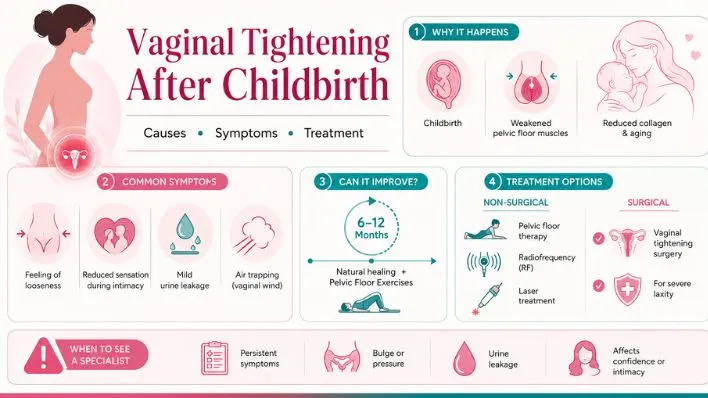
Is Vaginal Looseness After Delivery Permanent or Temporary?
For many women, it’s temporary, at least partially. The body has a natural recovery window, and most tissue and muscle tone rebuilds gradually over 6 to 12 months postpartum, especially with consistent pelvic floor engagement.
However, “temporary” doesn’t mean “complete.” Multiple deliveries, larger babies, prolonged labor, or tissue that tore or was cut (episiotomy) during birth can leave a degree of laxity that doesn’t fully resolve on its own.
This is normal, and it’s exactly why treatment options exist for the women who want further improvement beyond what natural healing provides.
Can Pelvic Floor Exercises Really Improve Vaginal Laxity?
Yes, to a meaningful degree, though expectations matter here. Kegel exercises, which involve repeatedly contracting and relaxing the pelvic floor muscles, are considered a first-line, evidence-supported approach for mild to moderate laxity and for improving muscle tone and bladder control.
Done correctly and consistently over weeks to months, they can noticeably improve the sensation of tightness and support.
For women who want a structured guide to exactly which exercises are safe and effective, including how to progress them safely, our article on exercising with pelvic organ prolapse covers pelvic floor strengthening techniques in detail, including the correct form for Kegels and when to modify intensity.
Where Kegels fall short is with tissue laxity itself, the loss of collagen and elastin structure in the vaginal walls. Exercise strengthens muscle, but it doesn’t rebuild connective tissue quality.
This is why some women do the exercises faithfully and still feel there’s a gap between muscle tone and actual tightness, which is a physiological limitation, not a failure on their part.
Vaginal Laxity vs. Pelvic Organ Prolapse: What Is the Difference?
This is one of the most common points of confusion, and it matters because the two conditions are managed differently.
|
Aspect |
Vaginal Laxity |
Pelvic Organ Prolapse |
|
What it is |
Loss of tightness or tone in the vaginal tissue |
Bladder, uterus, or rectum shifting from its normal position |
|
Main sensation |
Looseness, reduced friction during intercourse |
Heaviness, pressure, or a “falling down” feeling |
|
Visible signs |
Usually none, mostly a subjective feeling |
Can include a visible or palpable bulge at the vaginal opening |
|
Underlying cause |
Reduced collagen and elastin, weakened muscle tone |
Weakened pelvic support structures, ligaments, and connective tissue |
|
Can they occur together |
Yes, both share childbirth as a common risk factor |
Yes, laxity is often present alongside prolapse |
|
First step in care |
Pelvic floor exercises, non-surgical tightening |
Pelvic exam to assess severity and stage of prolapse |
Both share childbirth as a common risk factor, and they frequently occur together, but their treatment pathways can differ significantly.
For women who have been told they have mild prolapse and want to understand whether non-surgical management is a realistic option, our guide on how to fix a prolapse without surgery walks through the full range of conservative interventions, from pelvic floor therapy to pessaries, and when surgical referral becomes appropriate.
If you notice a pressure or bulging sensation rather than simple looseness, that’s a signal to have a pelvic exam rather than assume it’s ordinary postpartum laxity.
Does Vaginal Laxity Affect Sexual Sensation?
It can both partners, and this is one of the more emotionally difficult parts of the condition to talk about.
Reduced tightness can mean less friction during intercourse, which may lower physical sensation and satisfaction.
Some women also describe an increase in air becoming trapped and released from the vagina during movement or intercourse, medically related to the widened vaginal opening, which can feel embarrassing even though it is a normal physiological consequence of laxity, not a hygiene issue.
Beyond the physical side, there’s often an emotional layer: reduced confidence, self-consciousness during intimacy, or worry about a partner’s perception. These reactions are common and valid.
Sexual sensation changes related to laxity are a medical symptom, not a personal failing, and they respond to the same treatment approaches used for the physical tightness itself.
Do Non-Surgical Treatments for Vaginal Laxity Actually Work Long-Term?
For many women, yes, with realistic expectations about maintenance. Non-surgical options typically work by stimulating the body’s own collagen production or by strengthening pelvic floor muscles through targeted technology, rather than by removing or repositioning tissue as surgery would.
Options in this category include radiofrequency-based vaginal tightening, which uses controlled heat to encourage collagen remodeling in the vaginal walls, and electromagnetic or electrical muscle stimulation, which strengthens pelvic floor muscles more intensively than exercise alone.
Our dedicated vaginal tightening treatments page outlines the full range of laser, radiofrequency, and surgical options available at Ahalya Cosmetic Gynecology, Mumbai, including what each procedure involves, who it suits, and what realistic outcomes look like.
Results from non-surgical treatments generally build gradually over several weeks as collagen remodels, and they are not permanent in the way surgery can be.
Most non-surgical results last months to a couple of years depending on the technology, the individual’s tissue response, and ongoing pelvic floor maintenance, after which some women choose a repeat session.
They tend to suit women with mild to moderate laxity who want improvement without surgical recovery time.
Surgical options exist for more significant laxity or when prolapse is also present, and these are typically discussed only after a proper pelvic assessment.
When Should You See a Specialist About This?
If looseness is mild and you’re within the first year postpartum, giving your body time alongside consistent pelvic floor exercises is a reasonable first step.
It’s worth seeing a specialist if you notice a pressure or bulging sensation, pain during intercourse, or urinary leakage that isn’t improving or if the looseness is affecting your confidence or relationship and hasn’t improved after several months of self-directed effort.
A proper pelvic examination can clarify whether you’re dealing with laxity alone, prolapse, or both, which changes what treatment will actually help.
At Ahalya Aesthetic and Cosmetic Gynecology Clinic in Mumbai, our aesthetic and cosmetic gynecology team, including Dr. Jay Mehta, assesses each patient individually before recommending pelvic floor therapy, non-surgical vaginal tightening, or surgical options, based on the degree of laxity and the patient’s own goals. We focus on a clear diagnosis first so that any treatment recommended actually matches what’s happening in your body. Book a consultation with Dr. Jay Mehta today to receive a personalised vaginal laxity assessment and discuss the most suitable treatment options for your needs.
Final Thoughts
Vaginal looseness after childbirth is common, physically explainable, and in most cases treatable.
It isn’t a sign that something went wrong with your delivery or your body, and it isn’t something you have to simply live with if it’s affecting your comfort or confidence.
Whether the right next step for you is a few more months of pelvic floor exercises, a non-surgical tightening procedure, or a proper pelvic assessment to rule out prolapse, the important part is getting an accurate picture of what’s causing your symptoms before choosing a path forward.
Support and treatment for this are available, and asking about it is a normal, reasonable part of postpartum recovery.
Frequently Asked Questions (FAQs)
1. Does vaginal laxity go away on its own after breastfeeding stops?
Not directly, though oestrogen levels do rise again once breastfeeding ends, which can modestly improve tissue elasticity. Any remaining laxity from childbirth itself typically still needs exercise or treatment to improve further.
2. Can a C-section prevent vaginal laxity?
It reduces the risk somewhat since the vaginal canal isn’t stretched during delivery, but it doesn’t eliminate it entirely, since pregnancy hormones and pelvic floor changes still occur regardless of delivery method.
3.How soon after delivery can I start pelvic floor exercises?
Most women can begin gentle pelvic floor exercises within the first few weeks postpartum, once any tearing or stitches have started healing, though it’s best to confirm timing with your doctor at your postnatal check.
4. Is vaginal tightening treatment safe while breastfeeding?
Many non-surgical options are generally deferred until breastfeeding ends or hormone levels stabilise, since tissue response can differ during this period. This should be confirmed individually with your specialist.
5. Does vaginal laxity affect fertility?
No, vaginal laxity is a tissue and muscle tone issue and doesn’t affect ovulation, egg quality, or the ability to conceive.
6. Will vaginal tightening treatment hurt?
Most non-surgical options involve mild heat or muscle stimulation and are generally described as tolerable rather than painful, though sensitivity varies between individuals.
7. Can vaginal laxity come back after treatment?
Some gradual loosening can occur over time, particularly with aging, menopause, or subsequent pregnancies, which is why some women opt for maintenance sessions.
8. Is vaginal laxity the same as a "loose vagina" from being sexually active?
No, this is a common myth. Sexual activity does not cause vaginal laxity; the tissue naturally stretches and returns to shape. Laxity is driven by childbirth, aging, and hormonal changes, not sexual frequency.
9. What's the difference between vaginal dryness and vaginal laxity?
Vaginal dryness relates to lubrication and is usually hormone-driven, while vaginal laxity relates to tissue tightness and muscle tone. The two can occur together, especially around menopause.
10. Do I need surgery if I have both laxity and mild prolapse?
Not necessarily. Mild prolapse combined with laxity is often managed first with pelvic floor therapy and non-surgical tightening, with surgery reserved for more advanced or symptomatic cases.
Related Blogs

When Vaginal Itching Needs a Doctor’s Visit?
Itching isn’t always an infection. Mumbai’s Dr. Jay Mehta explains the real causes, and when self-treatment isn’t the right approach.
Surgical Treatment for Perineal Endometriosis: Wide Excision Explained
A painful lump that worsens with your period isn’t ordinary scar pain. Mumbai’s Dr. Jay Mehta explains diagnosis and when excision is needed.
Book Appointment
